Guardian
Healthcare | Hackathon | UX Design
An evidence-based guardian for mental health: Unobtrusive and automatic mental health tracking.
Duration: 2 Days | May.2019
Role: UX Design, UX Research, Psychology

A weekend-long hacking competition to democratize healthcare innovation.

MIT Sandbox provides seed funding for student-initiated entrepreneurship ideas, mentoring from within MIT and from a broad network of committed partners, and tailored educational experiences.
Solution Overview
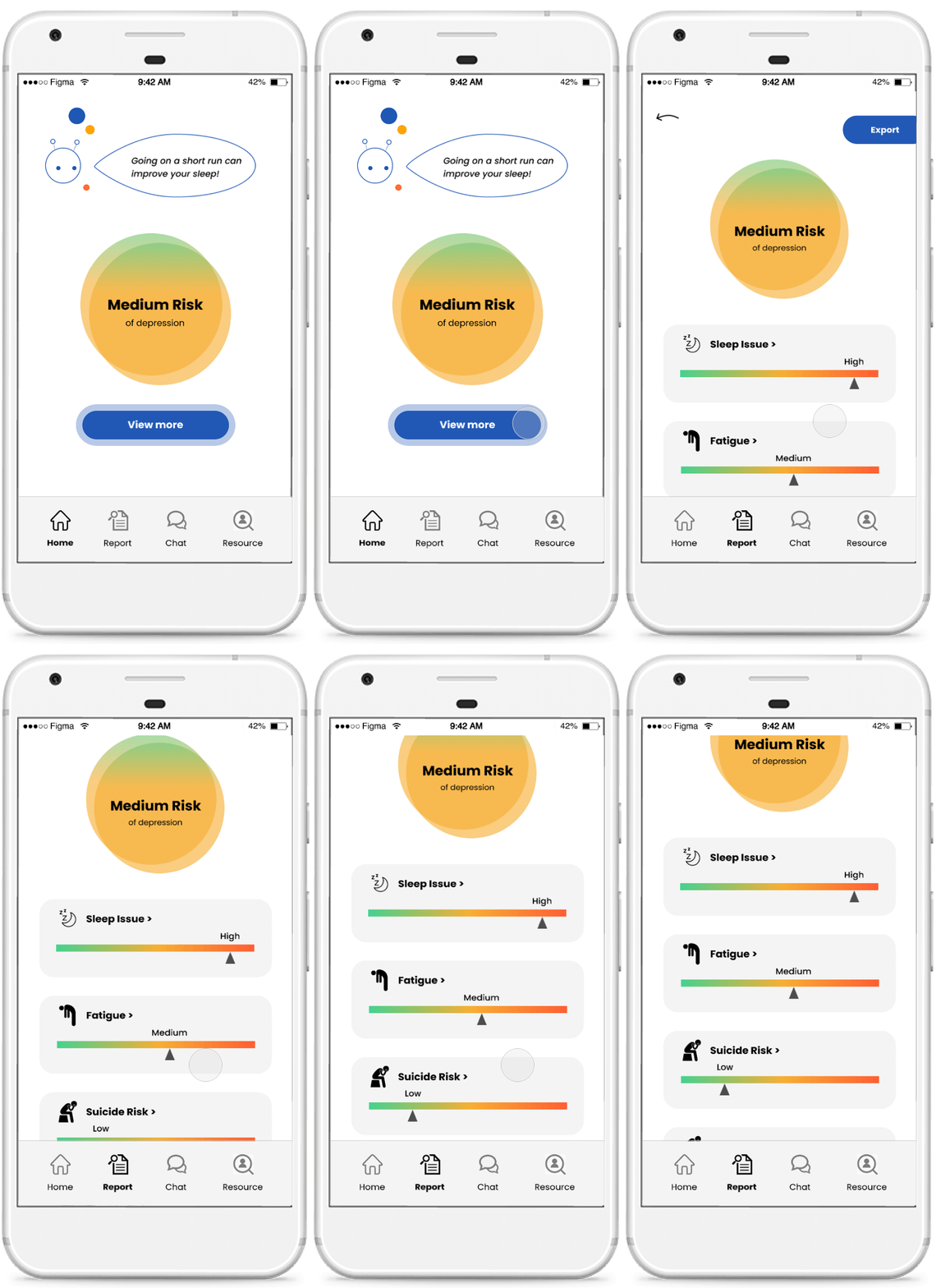
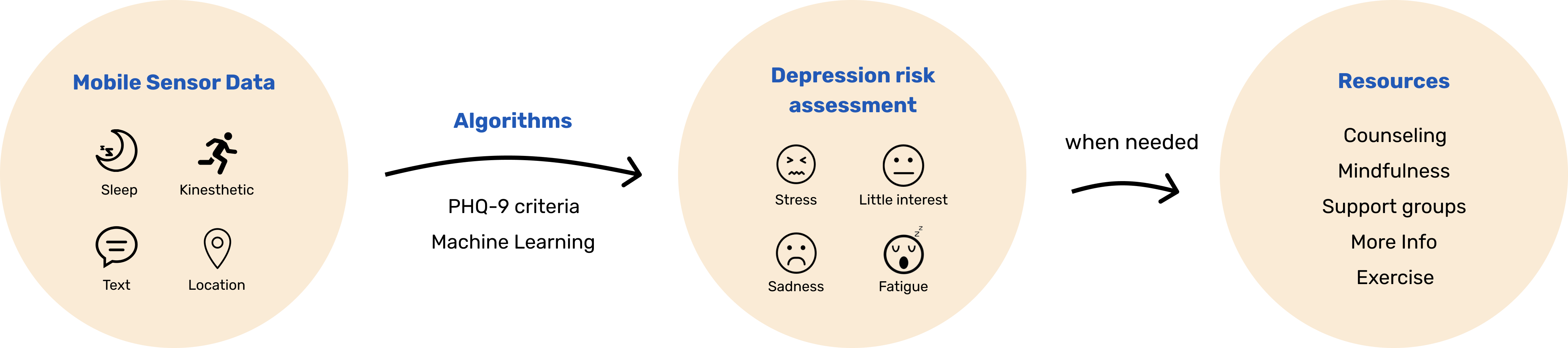
Based on clinical studies, Guardian utilizes all kinds of available mobile data, such as sleep duration, geolocation, and keyboard typing etc. to form a comprehensive and evidence-based analysis of users’ mental status. Such comprehensive method is the first of its kind.
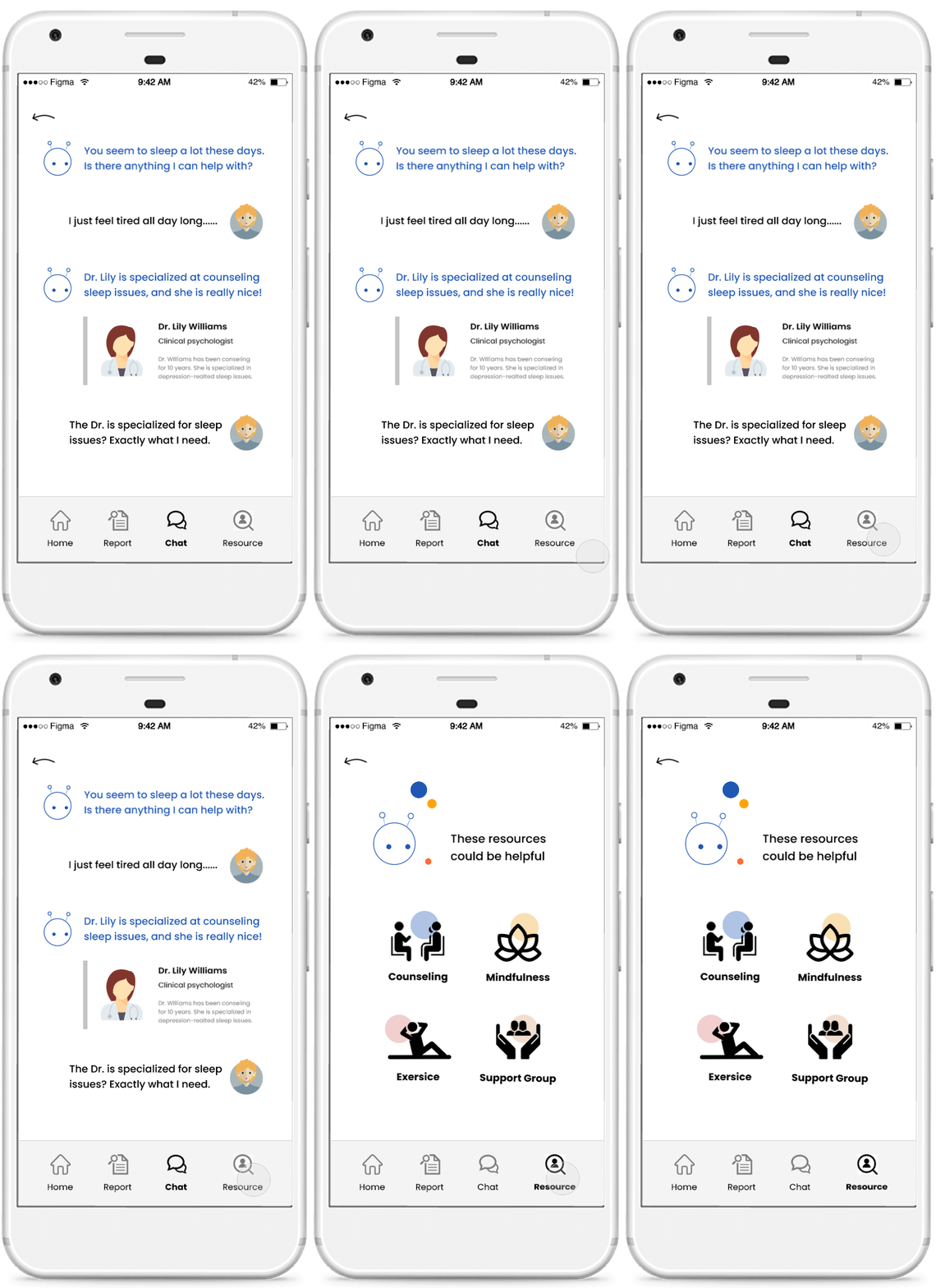
Based on users’ mental status, Guardian will connect users with the needed clinical resources privately. It achieves early detection and overcomes social stigma by enabling users to understand and care for their mental health independently and privately.
Generative Research

Depression impacts 7% American adults

It costs $210.5 billion a year

Early detection and treatment largely reduce emotional and financial burdens

Lack of diagnostic knowledge

Stigmatized to seek diagnosis and help

Hard to reach treatment resources
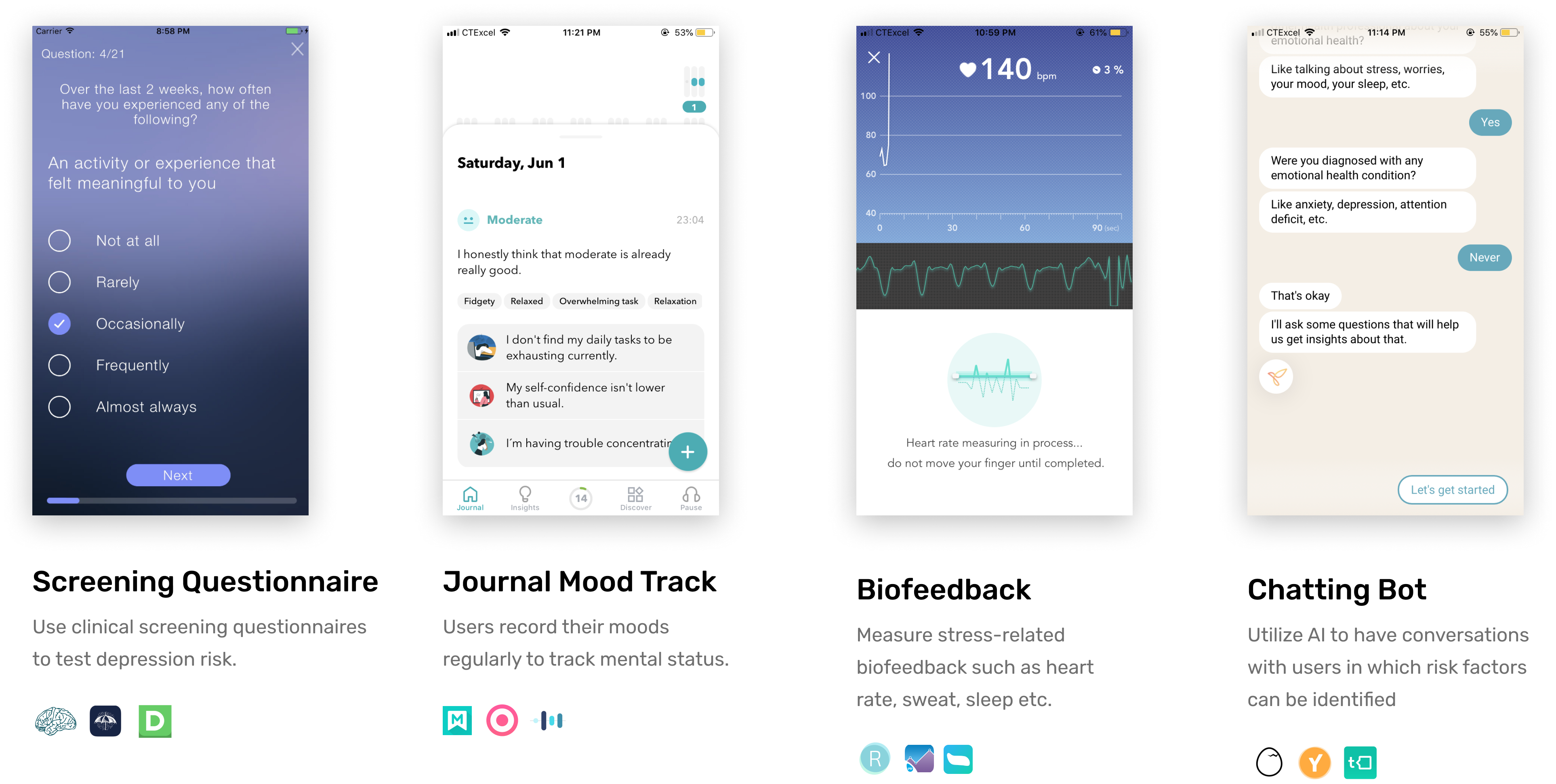
Depending on user input results in low adherence
Most current products rely on users’ input to assess depression risk, such as via questionnaire, journaling, or chatting. However, it is a heavy load, if not life-invasive, for users to keep regularly, especially for high stress populartions. So these products usually have low adherence over time.
A comprehensive assessment needs many factors and continuous tracking
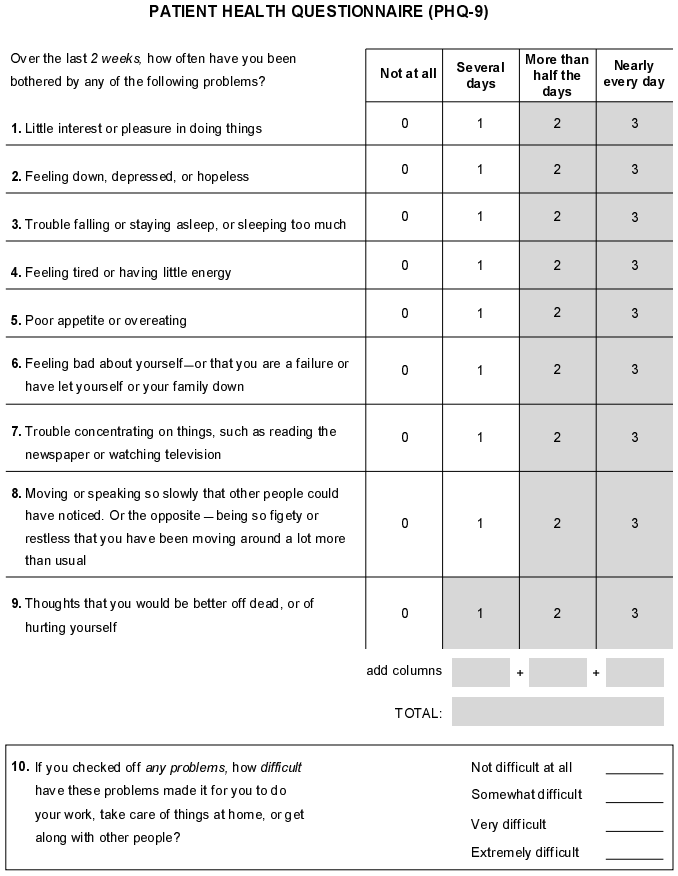
According to the newest authoritative diagnosis manual, DSM-V and PHQ-9, the diagnosis of depression requires five or more symptoms during the same 2-week period. However, current products mostly rely on single or very few factors and have difficulty gaining users’ continuous engagement.
What’s after detection? Connect users with resources.
Detection is only the beginning for users to care for their mental health. Due to the lack of knowledge, resources, and social stigma, it is difficult for most people to reach to mental health services on their own. Therefore, it is necessary that our product privately connects users with resources when in need.
Ideation

Only in a clinical setting

Largely rely on self-report

No “early” detection
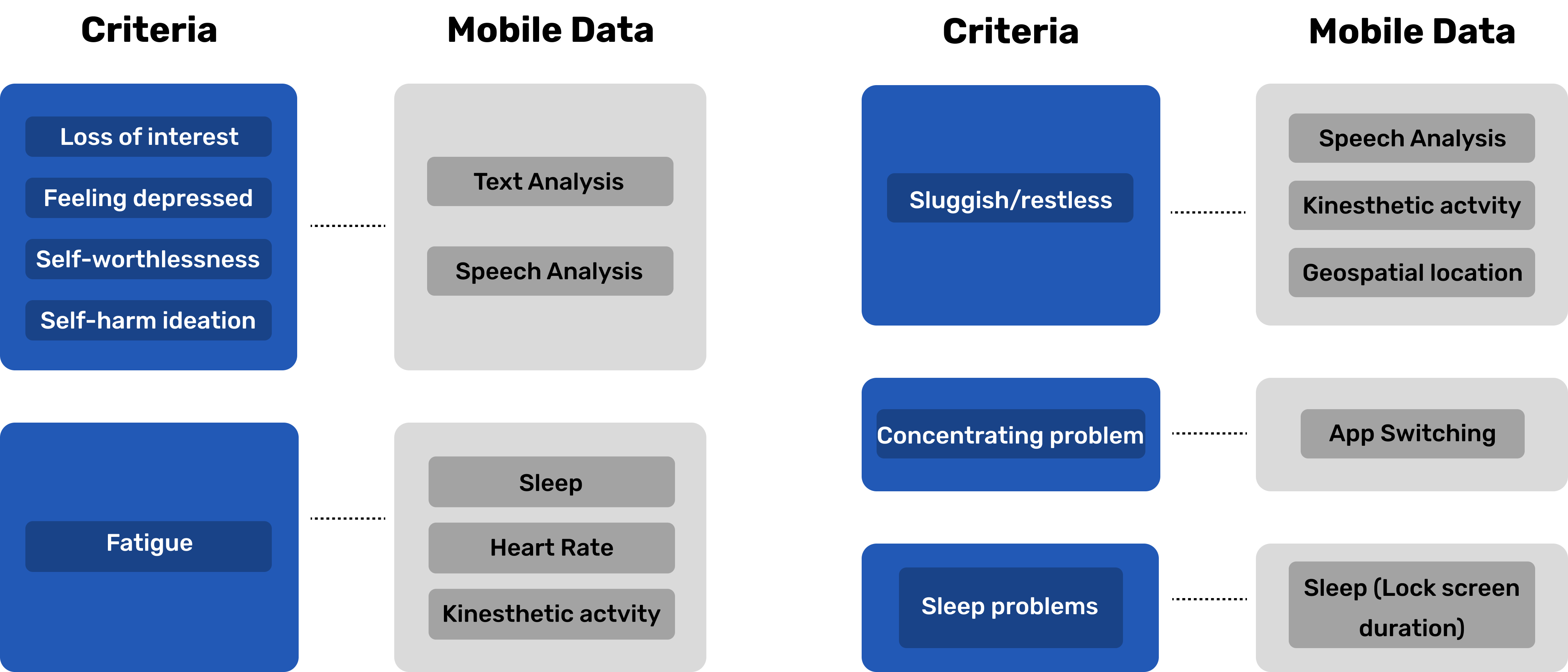
Why a mobile tracking product?
Minimal user burden: By using built-in mobile data for screening, we put minimal burden on users to provide input themselves, thereby effectively increasing the adherence of our product in the long term.
Comprehensive analysis: By integrating PHQ-9 and various kinds of built-in mobile sensor data, we are able to produce a comprehensive analysis of users’ mental status, the first of its kind.
Private: We empower users to understand their mental health status and gain clinical resources on their own privately. Free of social stigma, the under-diagnosis and under-treatment of depression would be tackled.
How does it work?
Design Decisions
Short, easy-to-understand report and warning
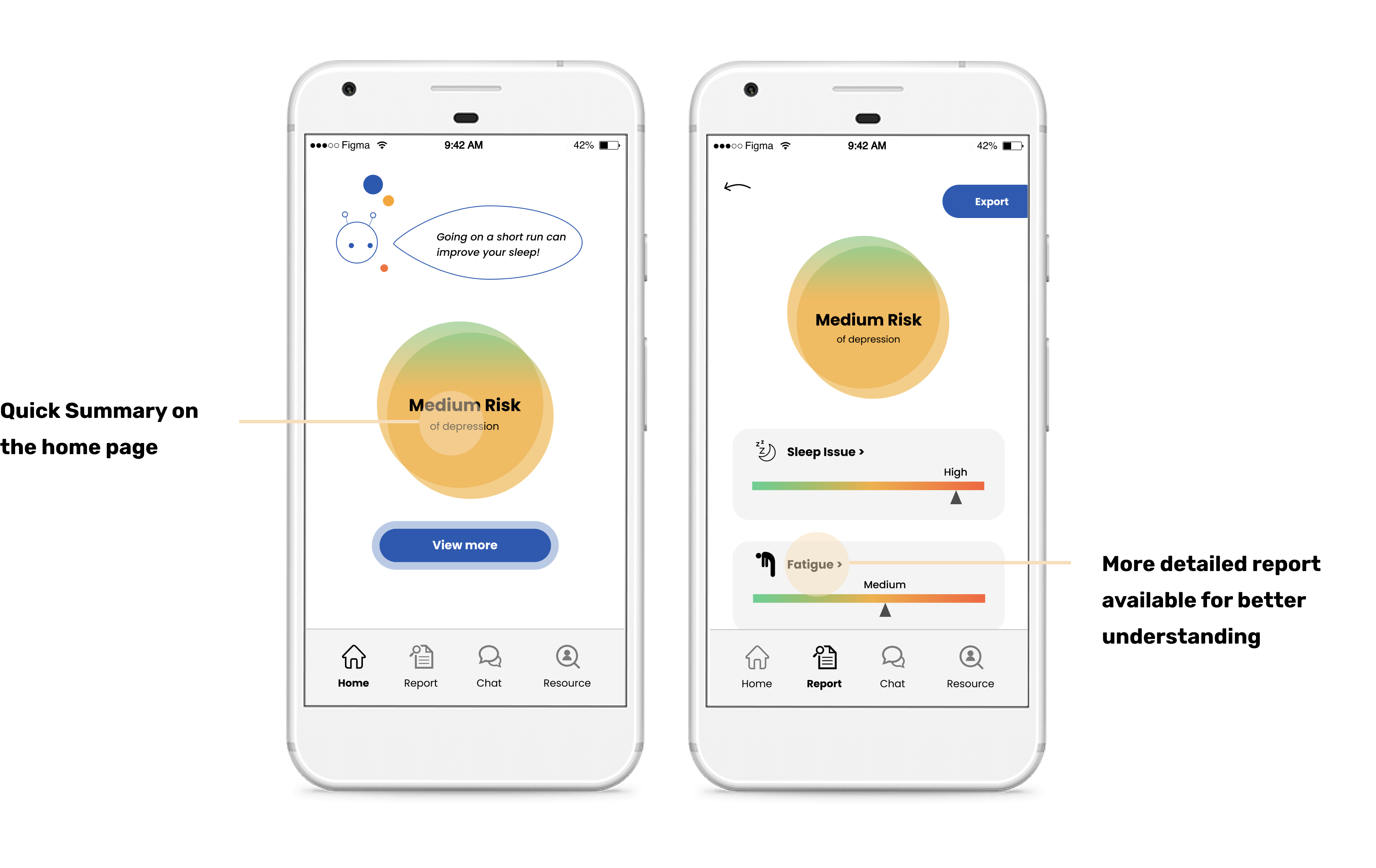
Personalize the product by an approachable figure
.png)
Business Model
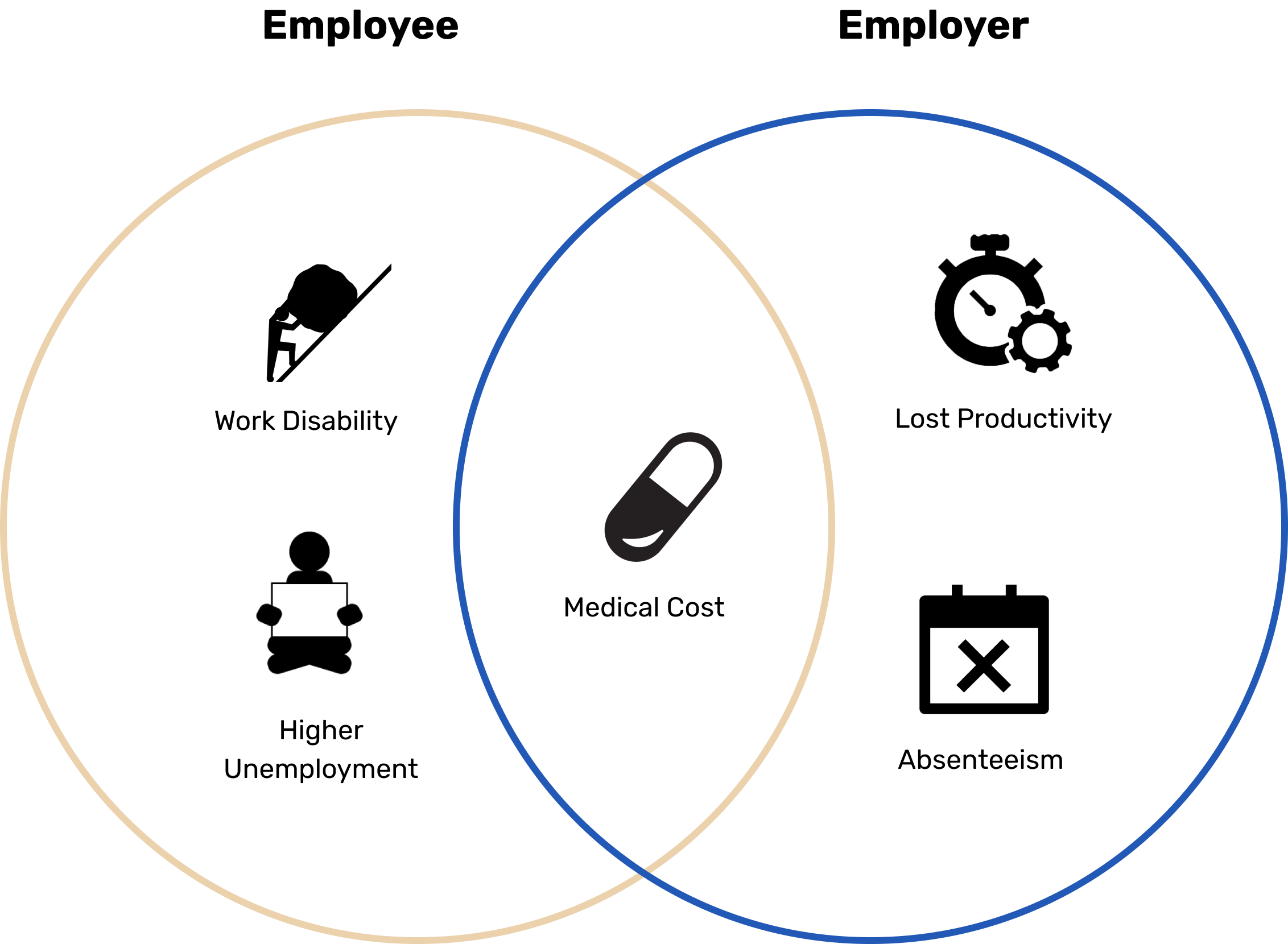

Employers and employees would share the subscription fee equally

Detect depression early to
save further medical costs

Guards employees’
mental health

Improve productivity
and absenteeism

Consulting

Investment banking

Medicine

Pilot program: AT Kearney Dubai
Our team has connections with the consulting firm, ATKearney, which has prolonged concern for employees’ mental health and has expressed interest in buying Guardian for their employees for a year as a pilot program.

Guards a growing population caring about mental health
As there is a growing population becoming aware of the importance of mental health, there’ll be a promising market potential for Guardian as a daily mental health care tool.

Guard children’s mental health
Compared with adults, it can be even harder for teens to understand and care for their mental health. Therefore, parents can buy Guardian to understand their children’s status and get a warning when needed.
Provide more data in between patients’ visits to clinicians
The data that Guardian generated can provide invaluable information to help clinicians track patients’ status in between their visits.
Reflections
01
Develop product in pressing time
Given only one day for product development, we managed to leave out the unnecessary and went straight to solving the core problems.
02
Lead an interdisciplinary team
My team was highly interdisciplinary: coder, doctor, consultant... Sparkles of creativity and intellectuality were happening all the time.
03
Apply UX skills in a new field
I quickly got familiar with the Psychiatric field and applied UX design to solve its most pressing problems.
04
Pitch to stand out in competition
Given just 3 minutes, we produced a winning pitch that explained Guardian in the regard of UX, Medical, Engineering, and business.

Ben-Zeev, D., Scherer, E. A., Wang, R., Xie, H., & Campbell, A. T. (2015). Next-generation psychiatric assessment: Using smartphone sensors to monitor behavior and mental health. Psychiatric rehabilitation journal, 38(3), 218.
Halfin, A. (2007). Depression: the benefits of early and appropriate treatment. The American journal of managed care, 13(4 Suppl), S92-7.
Emily A. Kuhl. Quantifying the Cost of Depression. Retrieved from http://www.workplacementalhealth.org/Mental-Health-Topics/Depression/Quantifying-the-Cost-of-Depression
© Jing Hu